Three weeks into the inaugural semester programme at FUNAAB, we sat down — anonymously — with students from the first cohort. What they shared was not about food. It was about what food makes possible.
We made a promise when we built ACFBI that we would not tell students' stories without their consent. So when we asked to speak with members of FUNAAB's first cohort, we expected polite silence. Instead, three students — whose names we will not publish — asked if they could share.
What follows are their words, lightly edited for clarity, with all identifying details removed.
"I stopped calculating."
A 300-level student, Faculty of Agriculture.
"Before the food pack, I had a system. I would calculate how many days were left before my aunt sent money and divide whatever I had by that number. Some days I would eat once. Some days I would drink a lot of water and call it fasting. I was not fasting. I was managing.
What changed is that I stopped calculating. I know that sounds small. It is not small. When you are not thinking about food, you start thinking about your studies. My scores in the last test were the best I have had in two years. I don't think that is a coincidence."
"I didn't tell anyone, and that was the whole point."
A 200-level student, Faculty of Food Science.
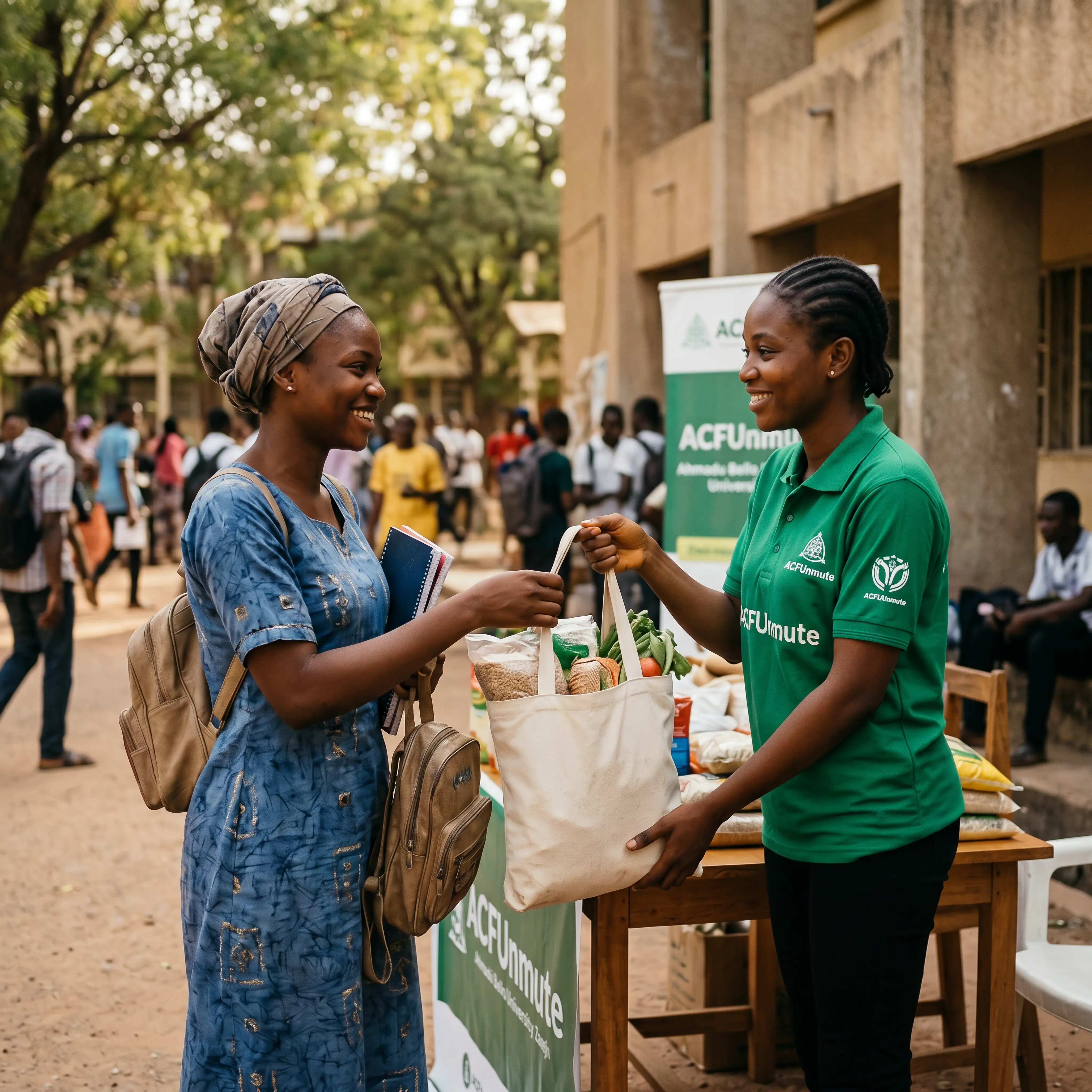
"I was afraid someone would see me. I thought the collection point would be in the open, like a queue everyone could see. It was not like that. I came, I showed my reference number, I left. Nobody else was there. The volunteer just nodded like it was nothing. Like it was completely normal to receive support.
That is the thing — they made it feel normal. Like it was a service, not a favour. I have not told my friends I am on the programme. I probably will not. But I know that if they needed it, they could access it the same way I did."
"My grades are not the most important thing right now. Staying in school is."
A postgraduate student.
"I lost my funding in July. I do not want to say how. I was seriously considering deferring my programme. I spoke to someone in the faculty who told me about ACFBI. I applied on a Tuesday. I received my first pack on Thursday. Two days.
I am still here. I am still enrolled. I will not defer. I think about what would have happened if there was no programme, and I do not like what I see in that version of events. So instead I think about what I want to do when I finish my degree."
What Three Weeks Tells Us
Three weeks into the FUNAAB programme, 47 students have received their semester packs. Nine emergency applications have been processed, with an average response time of 31 hours. Zero students have reported feeling stigmatised by the process — because dignity is not a feature of the programme. It is the programme.
These are early numbers from a first cohort at a first campus. We do not overstate them. But we also do not dismiss what they represent: proof that a model built around discretion, speed, and respect works. Students will use it. Students need it. Students deserve it.
There is a version of this story that stays at FUNAAB. We are not telling that version.
— Temitope Abolarin Co-Founder & Director of Strategy, ACFBI